Exhibition: Battersea Decorative Fair: 29 Sept - 4 October 2026
Henry Miller
We shall be taking a selection of paintings, works on paper, photography and sculpture from the gallery to the Battersea Decorative Fair from 29 Sept to 4 Oct. 2026. The fair is held at Evolution London, Battersea Park, London SW11 4NJ. (There is a free bus which leaves Sloane Square on a regular basis, which takes you directly to the fair.)
Henry will be exhibiting on Stand A27. Free tickets are available to attend the fair from 30 Sept to 4 Oct.. (We do not have tickets for the opening day.) Please show the ticket below on your phone, or print it off, to receive free entry to the fair. The tickets are not unique, so feel free to share with others who may want to come.
Below is a small sample of the collection of works that Henry will have with him at the fair. Do not hesitate to get in contact, should you have any queries about any of the works in his collection.
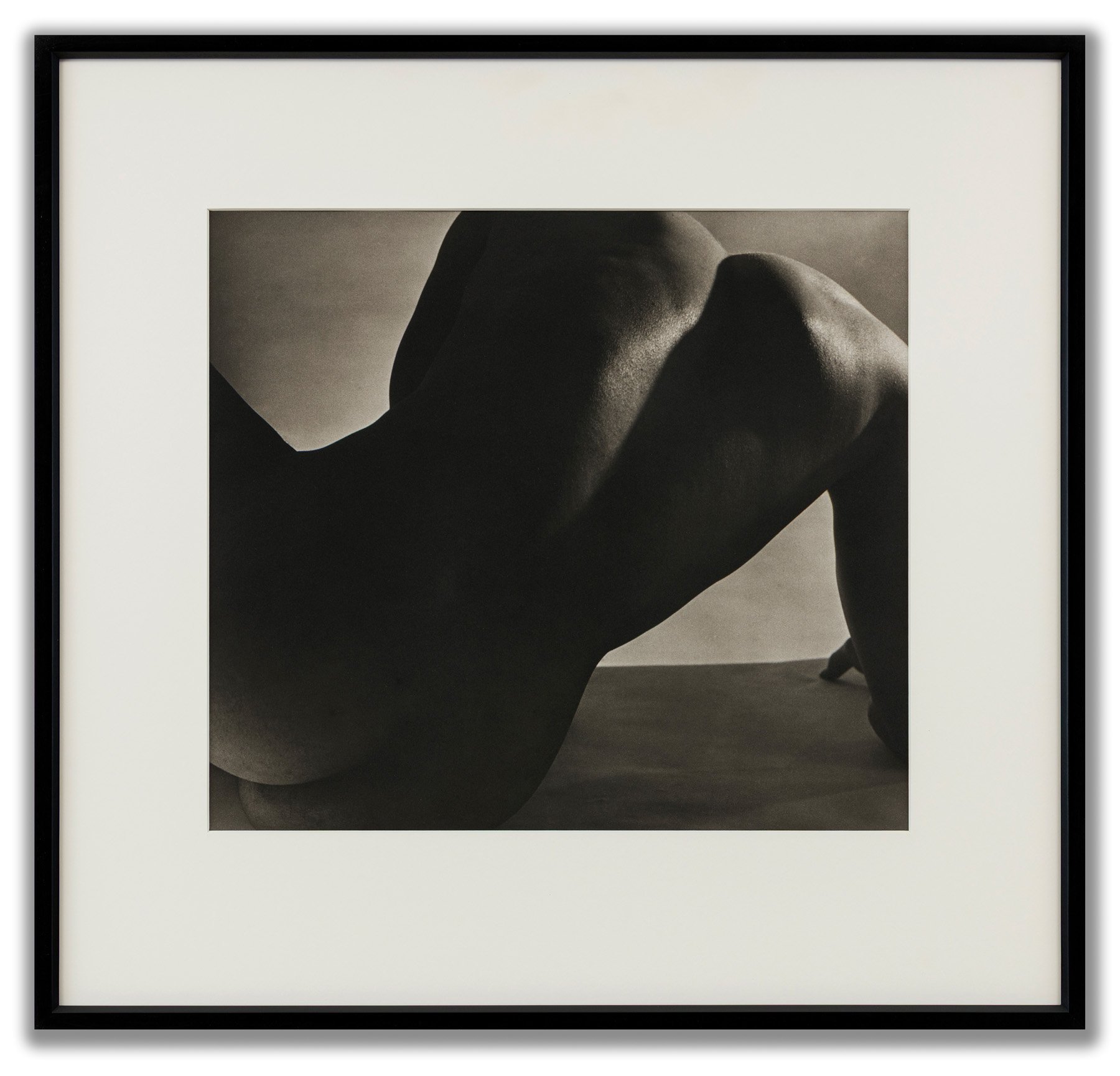
Horst P Horst, (American 1906-1999), Male Nude (Back Study I), 1952
£9,500
Platinum-palladium print (printed later)
Signed (lower right), also signed, numbered and inscribed (verso) 'Horst #46 6/15'.
38cm × 43cm (image size), 4cm × 56cm (sheet size) (61cm × 64cm framed)
One of the 20th century's premier photographers, Horst was a master of light, composition and atmospheric illusion who conjured a world of sensual sophistication. Working mainly in Paris and New York, Horst created images that transcend fashion and time. In the early 1950s, Horst produced a set of distinctive photographs unlike much of his previous work. The studies highlight Horst's sense of form, emphasising the idealised human body, using light and shadow. Monumental and anonymous nudes resemble classical sculptures. This image is one of a number of nudes that he exhibited for the first time in Paris in 1953. In the 1980s, he reprinted the images himself to make them available to buy, following a resurgence of interest in his work.
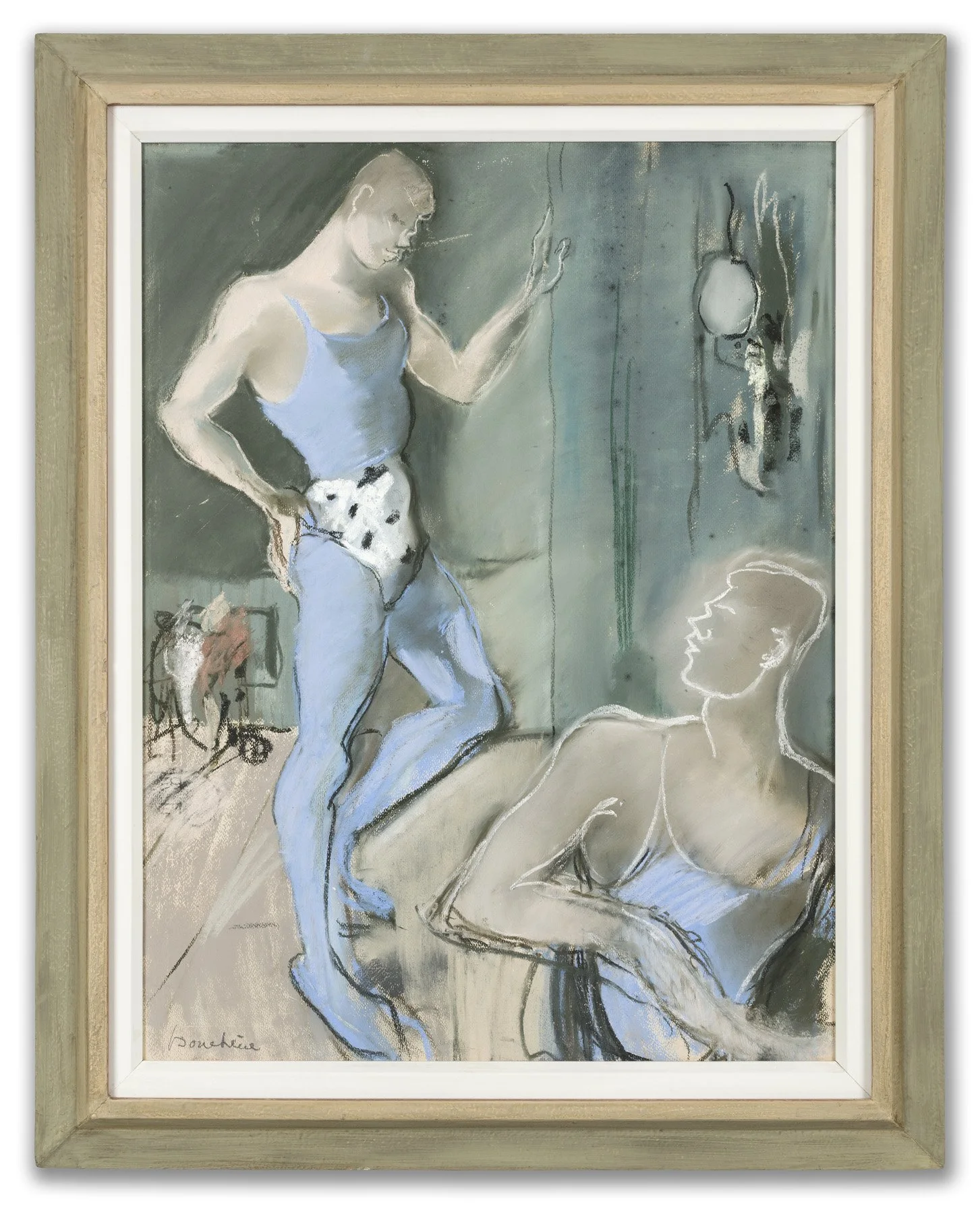
Dimitri Bouchène, (Russian 1893-1993), Dans la loge, c.1920s
£3,750
Pastel on paper
Signed (lower left)
63cm x 49cm (75cm x 60cm framed)
Dimitri Bouchène was a Russian-born painter and theatrical designer who spent the vast majority of his long career in France, earning acclaim for his contributions to the Mir Iskusstva (World of Art) movement, post-Impressionist landscapes, and high-fashion collaborations. Born in Saint Petersburg, Bouchène fled revolutionary Russia in 1925 and quickly integrated into the Parisian beau monde, forging close friendships with cultural icons like Anna Pavlova, Alexander Benois, and Nina Ricci. While widely recognised for his exquisite stage sets and costume sketches for the Paris Opéra and La Scala, a compelling facet of his oeuvre lies in his intimate, expressive male figurative work.
Bouchène’s approach to the male form was deeply shaped by his background in dance design and the classical traditions of European figure drawing. Through his male figure studies, Bouchène captured the elegance and vitality of the male form with a characteristically lyrical, French-Russian sensibility, solidifying his reputation as a master draftsman of human movement.

Ian Rank-Broadley, (British, b.1952), Standing Figure: Arms Raised, 2006
£3,250
Bronze
Numbered 4/10
31cm × 9cm × 14cm (incl. base)
Ian Rank-Broadley is one of the foremost sculptors working today. His effigy of the late Queen Elizabeth II appears on all UK and Commonwealth coinage from 1998. He has numerous other public works, including at the Armed Forces Memorial. Most recently, he created portraits of King Charles and the Queen from life.
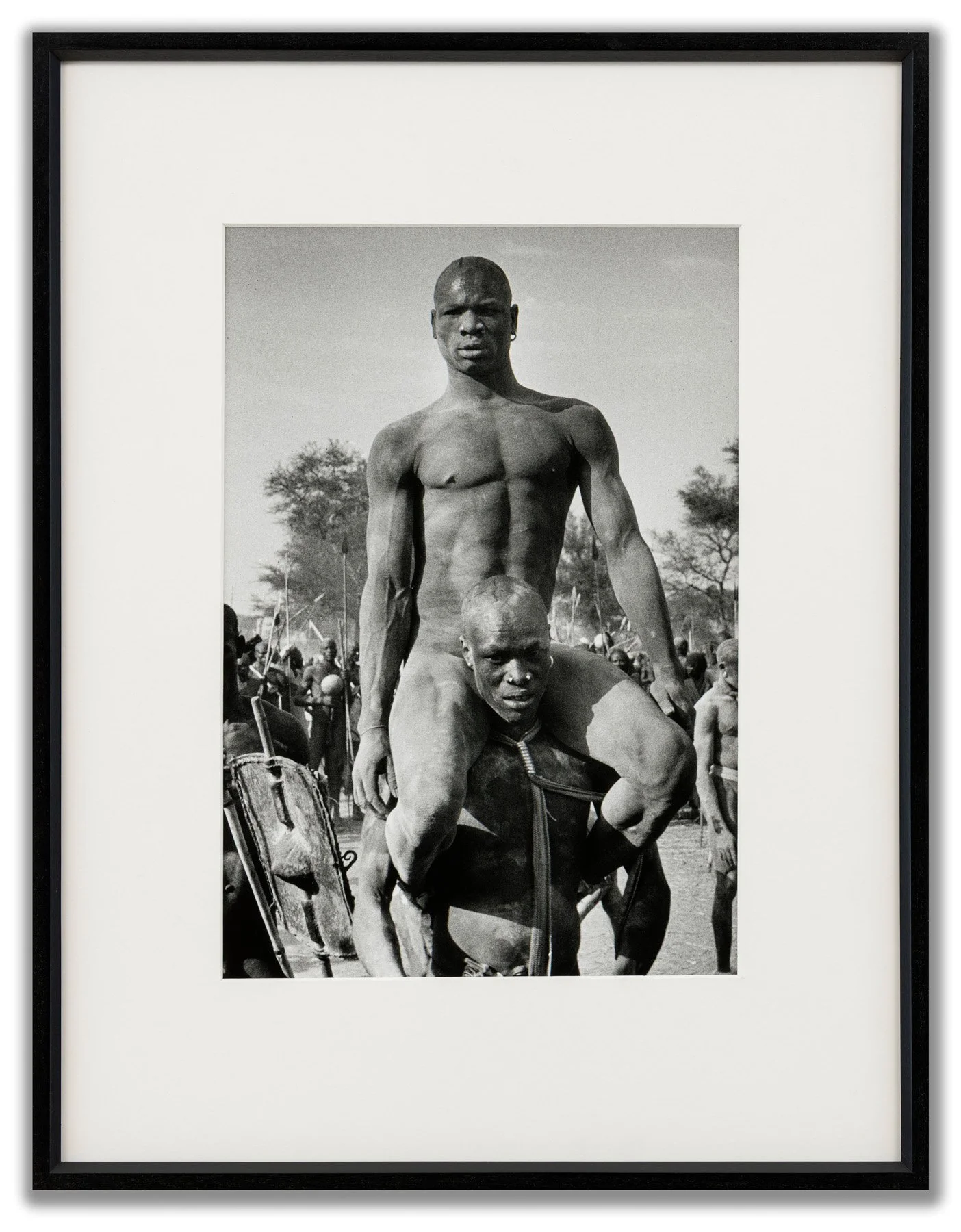
George Rodger, (British 1908-1995), Korongo Nuba Wrestler, Kordofan, South Sudan, 1949
£3,950
Silver print (printed 1993 by the photographer)
Signed (recto and verso) with studio stamp and print information (verso)
33cm × 23cm (image size), (50cm × 39cm framed)
George Rodger was a pioneering British photojournalist and co-founder of Magnum Photos, celebrated for his empathetic documentary work across World War II, Africa, and the Middle East. In 1947, alongside Robert Capa, Henri Cartier-Bresson, and David "Chim" Seymour, Rodger co-founded Magnum Photos, a revolutionary photographer-owned agency that granted artists control over their copyrights and assignments.
Rodger spent much of his post-war career documenting traditional societies, rituals, and changing cultures across Africa and the Middle East. His work prioritised dignity and avoided sensationalism, creating one of the mid-20th century’s most vital ethnographic photographic archives. He passed away in Kent, England, in 1995 at age 87.
In 1949, while undertaking an extensive 28,000-mile overland journey from Cape Town to Cairo for National Geographic, Rodger traveled into the Nuba Mountains in the Kordofan region of Sudan. There, he spent six weeks living alongside the Korongo Nuba community, becoming the first Western photojournalist granted permission to extensively document their sacred traditions and daily life.
The photograph depicts the aftermath of a ritualistic Nuba wrestling match. A victorious wrestler—his body coated in ash and clay used for ceremonial grip and protection—is carried atop the shoulders of another tribe member in triumph. First published in National Geographic (1951), later included in Edward Steichen’s landmark The Family of Man exhibition at MoMA (1955).
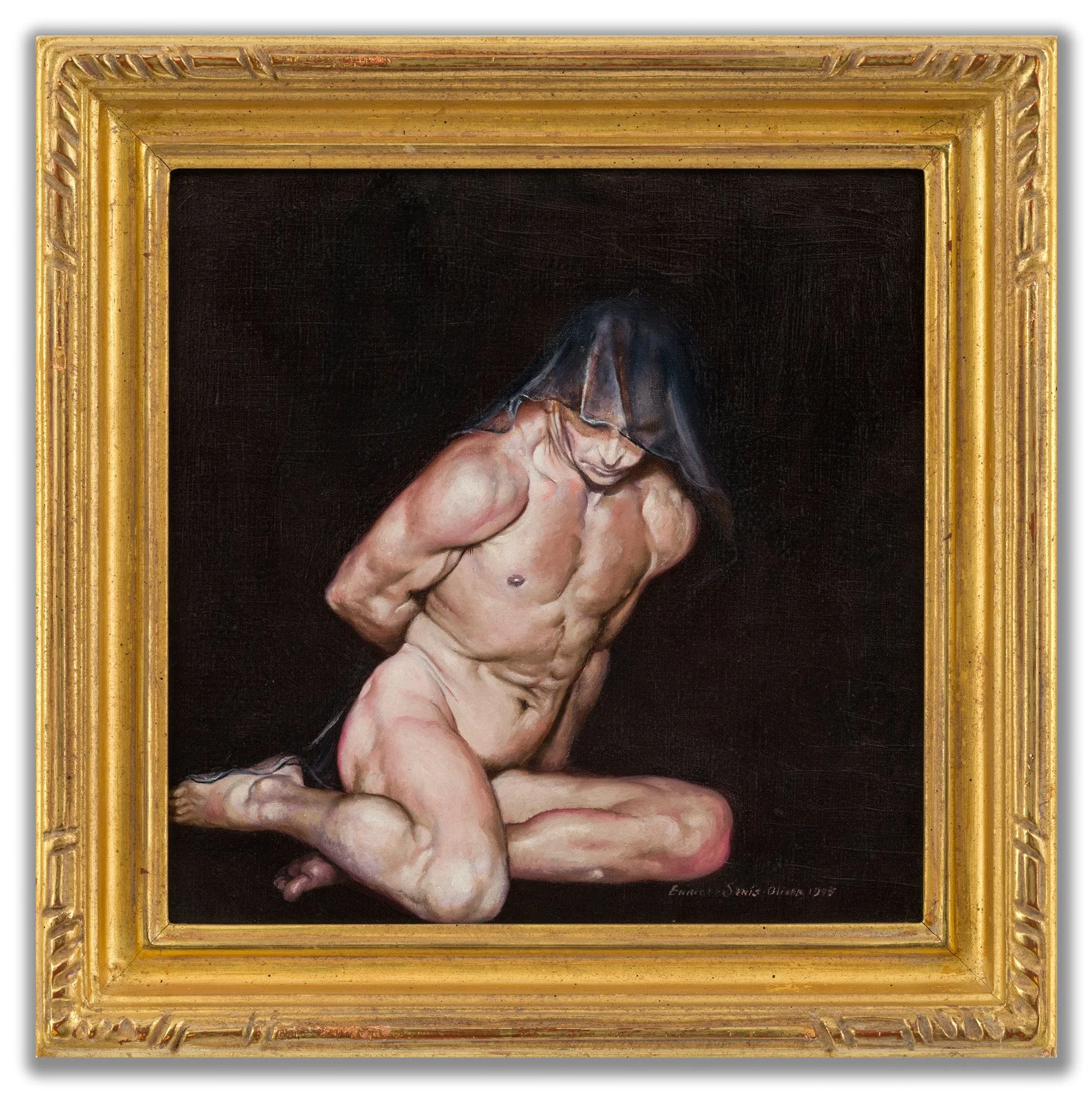
Enrique Senis-Oliver, (Spanish b.1936), Male Nude with Mantilla, 1976
£1,500
Oil on canvas
Signed and dated (lower right)
26.5cm × 26.5cm (34.5cm × 34.5cm framed)
Enrique Senís-Oliver is a Spanish painter renowned for his precise anatomical mastery, vivid Neo-Realism, and prominent high-society portraiture. Originally studying civil engineering, he shifted focus to art in 1957 and studied anatomy at the San Fernando Royal Academy of Fine Arts in Madrid to refine his understanding of human form. During the late 1950s, Senís-Oliver travelled across Europe—painting portraits in Switzerland, Belgium, Germany, and Greece. His subjects included heads of state and influential figures such as King Juan Carlos I of Spain, shipping magnate Aristotle Onassis, and Greek Prime Minister Konstantinos Karamanlis.
Moving to New York City in 1961, he established himself within the American Neo-Realist movement. His most celebrated U.S. commission came from the Harkness Foundation to design the interior and execute large-scale stage murals for the Harkness Theatre for Dance at Lincoln Center—a project completed over nearly two years in the early 1970s. In 1982, he relocated to Southern California, exhibiting at the Bridge Gallery in Los Angeles City Hall following an invitation by Mayor Tom Bradley. Returning to his native Valencia in the 1990s, he was honoured with a major retrospective at the Palace of Marqués de Campo in 1993. In 2000, the Universitat Politècnica de València commissioned him to paint a monumental ceiling mural spanning over 200 square metres.
Usually worn by women, a mantilla veil is a traditional Spanish head covering made of silk or tulle with a heavy lace edge. It drapes flat over the head and shoulders without gathering, creating a soft frame around the face. It is popular for weddings and religious services.
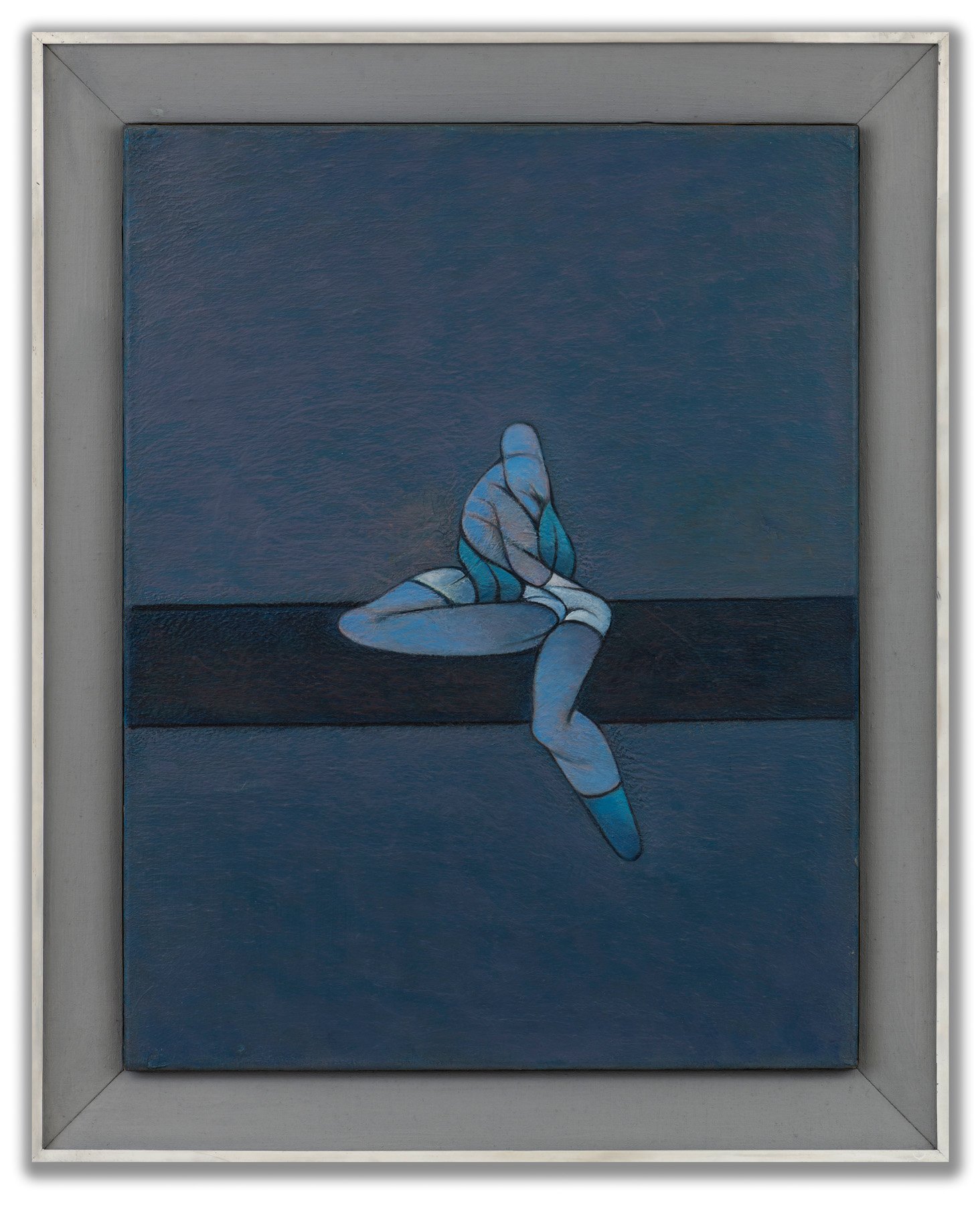
Wilfred Avery, (British 1926-2016), Vigil, 1965-1969
£6,000
Oil on canvas, Signed and dated (verso), 91cm × 71cm (110cm × 89cm framed)
Wilfred Avery was a British modern painter and collagist whose six-decade career focused primarily on two interwoven subjects: the natural landscape and the male figure. Influenced by Cubism, depth psychology, and his own identity as a gay man, Avery produced enigmatic, deeply personal works that bridged the physical and psychological worlds. Born in South Molton, Devon, his upbringing near the rugged Devon coastline instilled a lifelong love for the English countryside, a motif that recurred throughout his work.
Avery studied painting at St Paul’s College in Cheltenham. During his studies, he met the influential British artist Paul Nash, who encouraged him to look toward Paris and modern European artists—such as Paul Cézanne, Georges Braque, and Pablo Picasso—rather than London or New York for inspiration. Moving to London in 1952, Avery began showing at prominent post-war galleries, including Helen Lessore’s Beaux Arts Gallery and Victor Musgrave’s Gallery One. During the late 1950s, he also designed theatre sets alongside his twin brother, Samuel Lock.
Early in his career, Avery depicted male figures in quiet, intimate, domestic spaces. At a time when homosexuality was criminalised in the UK, his artwork presented radical yet tender portrayals of the male form and intimacy. From the late 1950s onwards, he developed a thick impasto style, capturing the hills, cliffs, and waters of Devon and Yorkshire in semi-abstract, Cubist-influenced forms. Heavily influenced by the analytical psychology of Carl Jung, Avery embraced what he called "the unpredictable image"—allowing the subconscious to guide his composition. Over time, he fused the forms of the human body and natural landscapes into unified, morphing shapes.
Avery lived a quiet life focused intently on his studio practice, settling in Blackheath, Southeast London, for much of his later career. He passed away in Eastbourne on April 26, 2016. Today, his work is held in several public and private collections across the United Kingdom and internationally, including The Ingram Collection, The Jerwood Collection, the Royal Albert Memorial Museum, and Sheffield Museums.